Korea will put the tax the chip boom threw off into a fund, and rewrite a school funding formula that has not changed in half a century
Two pages into the agenda paper there is an equation.
It reads: the previous year's grant, multiplied by one plus the three year average nominal growth rate, multiplied by one plus 35 percent of the three year average change in the school-age population. That is what South Korea proposes to pay its provincial education authorities from now on. For half a century the answer has been a single line instead: 20.79 percent of internal tax revenue, whatever internal tax revenue happened to be.
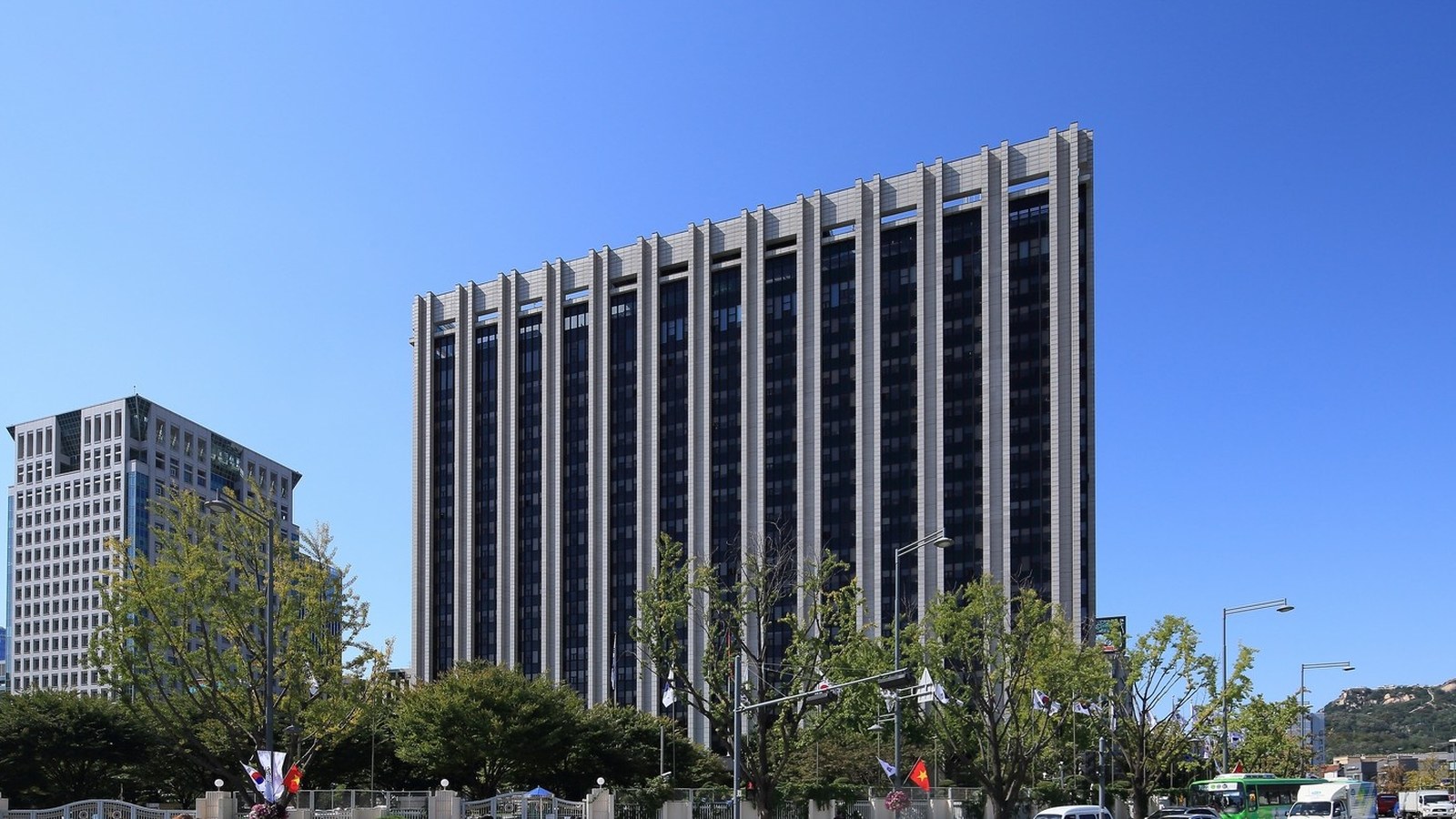
Planning and Budget Minister Park Hong-keun put that change, and a new fund to hold the money the semiconductor boom has thrown off, to the first meeting of a Fiscal Management Strategy Council at the Government Complex Seoul on Friday morning. The Education Minister, the Vice Minister of the Interior and Safety and 14 outside members sat with him. The ministers briefed jointly at 11:10.
The fund
The Future Response Fund takes two kinds of money, and the agenda paper is careful to separate them.
Windfall revenue is the amount by which next year's internal tax revenue budget exceeds a trend line. The trend is not a forecast. It is arithmetic on the past: the 2025 settlement figure, grown twice at the average annual rate of the previous ten years, 2015 to 2025. Surplus revenue is a different thing, being the gap between the original revenue budget and the September re-estimate that article 55-2 of the National Finance Act requires. Leftover year-end surplus and the fund's own investment returns go in as well.
The mechanism runs both ways, which is the part worth reading twice. Where the revenue budget comes in below trend, money moves out of the fund and into the general account. Where a revenue shortfall opens up in year, the same thing happens.
Five accounts sit inside it: a general account, and one each for youth, growth engines, the regions, and education and talent. Idle balances go to a dedicated manager with a minimum return target set above the risk-free rate, which the paper prints as the three year treasury yield of 3.85 percent at the close on 18 August.
Neither document says how large the fund will be.
The demographic arithmetic
The case for touching the grant is two footnotes on page 3 of the release.
Between 2010 and 2025 the population aged 3 to 17 fell from 8.80 million to 5.91 million, a drop of 2.88 million or 32.8 percent. Over the same fifteen years the grant rose from 32.3 trillion won to 70.3 trillion, an increase of 38 trillion won or 117.6 percent. One line went down by a third while the line that funds it more than doubled, because the two were never connected to each other. The grant was connected to tax.
The ministry pairs that with a comparison of per-student public spending against the OECD for 2022, in thousands of dollars. Primary and secondary schooling: 22.5 against an OECD 13.5. Higher education: 14.7 against 21.4.
Two things soften the new formula. Only 35 percent of the demographic change is applied, which the paper attributes to the share of education budgets locked into salaries and other fixed costs. And there is a floor: where the total would come in below the previous year, the state makes up the difference.
The 20.79 percent line does not disappear entirely. The gap between it, measured on internal taxes excluding the windfall, and the smaller number the new formula produces is booked as income to the education and talent account inside the fund, earmarked for early childhood, higher and lifelong education, and for attracting and keeping skilled workers.
The local share tax that funds municipalities is touched more lightly. Its rate stays at 19.24 percent of internal taxes. What changes is the base, which now excludes whatever has been transferred into the fund.
What happens next
The ministry gives the reason for the hurry in a series on page 7 of the agenda paper, which puts Korea's potential growth rate at 2.5 percent across 2020 to 2024, 1.9 percent in 2025, and a forecast 1.7 percent this year and 1.5 percent next.
The package bills go out for legislative pre-announcement from Monday to Thursday this week. Cabinet takes them on 1 September. They reach the National Assembly on 3 September, alongside the 2027 budget.