The part of a Southwest Florida tax bill that no exemption touches
Lee County governments and districts put $426.6m of non-ad valorem assessments on the 2025 tax roll, equal to almost a third of the property tax they levied. In Collier the figure was $120.1m. Homestead exemptions and value caps do not reach any of it.
Thirty-three dollars. That is roughly what Lee County property owners were charged in non-ad valorem assessments for every $100 of property tax levied on the 2025 roll, according to the Florida Department of Revenue's county reports. In Collier the figure was about $13.
These are the charges in the lower half of a Florida tax bill. Trash collection, fire service, stormwater, street lighting and the debt of a community development district all arrive in the same envelope as the school and county millage, and they are collected by the same tax collector on the same schedule. They are not calculated the same way, and that one difference decides who pays them, what reduces them and what the federal return will allow.
The ad valorem half has been explained many times, including in our walk through Florida's millage calculation. This piece is about the other half, built from the state's own data on what local governments in Lee and Collier put on the 2025 roll.
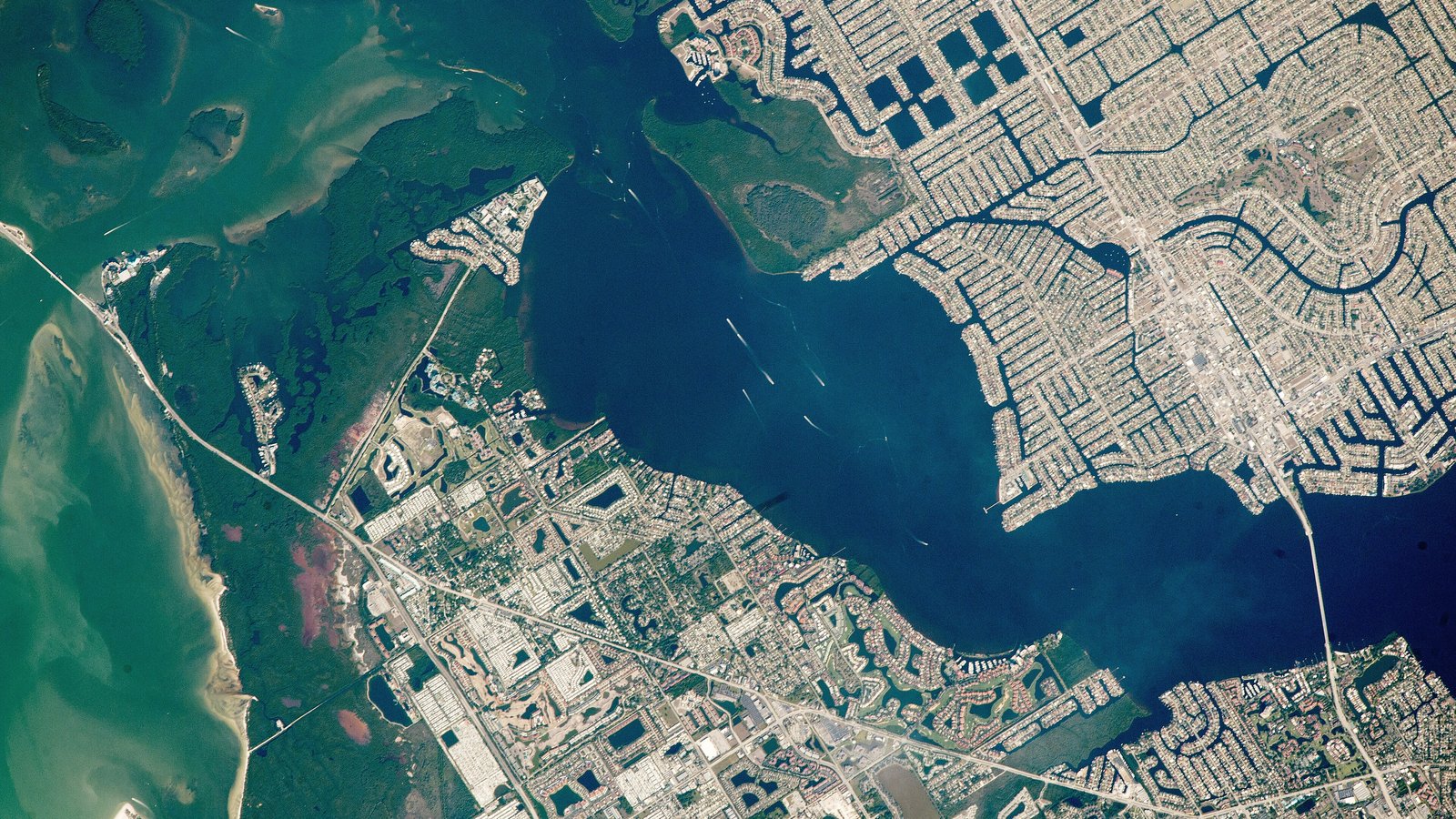
Photograph: ISS Expedition 47 crew / NASA, public domain; cropped.
What are non-ad valorem assessments?
Non-ad valorem assessments are charges on a Florida property tax bill that are not based on millage. Florida law defines them as assessments not based on millage that can become a lien against a homestead. They pay for services or improvements tied to the property, such as trash collection, fire protection, stormwater and district infrastructure.
The definition sits in section 197.3632 of the Florida Statutes, which governs what the law calls the uniform method: the route by which a county, city or special district hands its assessment roll to the tax collector instead of sending its own bills. The words that matter are "not based upon millage." An ad valorem tax is a rate applied to taxable value. A non-ad valorem assessment is a dollar amount fixed by some other unit: a parcel, a dwelling unit, a front foot, a square foot of building, an acre, or a calculated benefit.
The legal theory is benefit. A property that receives a service, or sits inside a district that built something, pays for it in proportion to some measure of what it gets. That is why the charges can differ sharply between two houses of identical value a mile apart.
Two houses on the same street can carry the same assessment while one is worth three times the other. Two houses of equal value in neighboring districts can carry very different ones.
How much do Lee and Collier put on the bill?
On the 2025 tax roll, governments and districts in Lee County levied $426.6m in non-ad valorem assessments against $1.30bn of ad valorem taxes, a ratio of 32.87 percent. In Collier the total was $120.1m against $916.3m, or 13.11 percent. The statewide ratio was 17.82 percent.
The Department of Revenue compiles these numbers because the statute makes it. Under section 197.3632(5)(b) every tax collector must send the department a copy of each non-ad valorem roll by December 15, with a report giving the levying body, the basis and rate of the levy, the total levied and the number of parcels. The department publishes the totals for fiscal year 2025-2026, which corresponds to the 2025 roll billed last autumn.
| 2025 roll | Non-ad valorem assessments | Ad valorem taxes levied | Ratio |
|---|---|---|---|
| Lee, all levying bodies | $426,617,795 | $1,297,886,045 | 32.87% |
| Collier, all levying bodies | $120,095,764 | $916,348,620 | 13.11% |
| Charlotte, all levying bodies | $177,816,516 | $316,850,435 | 56.12% |
| Sarasota, all levying bodies | $285,778,484 | $731,666,619 | 39.06% |
| Florida | $6,474,728,792 | $36,342,317,662 | 17.82% |
Source: Florida Department of Revenue, 2025 non-ad valorem assessments as a percentage of ad valorem taxes levied.
Collier is the outlier in Southwest Florida, and it is an outlier on the low side. Charlotte's assessments are worth more than half of everything it levies through millage. Lee sits close to a third.
Statewide the total is rising. The department's comparison table puts all non-ad valorem levies at $5.74bn on the 2024 roll and $6.47bn on the 2025 roll, an increase of 12.85 percent in one year.
Why is Lee's share so much higher than Collier's?
Lee's share is higher mainly because of who levies and for what. Lee's cities collect $193.5m in assessments against $303.8m of city property tax, and Lee's independent districts collect $145.5m, much of it for fire and community development. Collier's cities levy almost none, and Collier's assessment rolls carry no fire charge at all.
The breakdown by type of government is where the two counties part company.
| 2025 roll | Lee | Collier |
|---|---|---|
| County government | $87,606,945 (12.63% of county tax) | $50,869,678 (8.21%) |
| Municipalities | $193,530,747 (63.71%) | $1,906,400 (2.47%) |
| Independent special districts | $145,480,103 (48.46%) | $67,319,687 (30.68%) |
The municipal line is the striking one. For every $100 that Lee's cities raise from millage, they raise another $63.71 through assessments. The Department of Revenue's city table shows what those assessments are for: $82.6m for fire control, $44.7m for solid waste, $34.8m for drainage and water management, and $28.0m for water and sewer.
Fire is the clearest single difference. Across Lee, the state counts $124.3m of non-ad valorem fire assessments on the 2025 roll, $82.6m levied by cities and $41.7m by independent districts. Collier's column for fire control is empty. That does not mean Collier fire service is free. It means none of Collier's fire cost reaches the bill as a per-parcel charge, so whatever share owners carry arrives through millage or other revenue, which a homestead exemption can reduce.
Our brief on Cape Coral's fiscal 2027 assessment resolutions shows how one Lee city builds such a charge, with a flat tier for every parcel and a second tier tied to the value of the structure rather than its taxable value.
What do the assessments pay for?
In Lee, the largest categories on the 2025 roll were solid waste at $131.5m, fire control at $124.3m and community development or redevelopment at $86.3m. In Collier, community development and redevelopment led at $42.0m, followed by solid waste at $39.0m and $37.9m the state classifies only as other.
| 2025 roll, by function | Lee | Collier |
|---|---|---|
| Solid waste | $131,450,848 | $38,980,030 |
| Fire control | $124,316,105 | none |
| Community development or redevelopment | $86,252,030 | $42,034,145 |
| Drainage and water management | $43,907,446 | $275,687 |
| Water and sewer | $28,070,542 | $932,338 |
| Lighting | $162,003 | none |
| Road improvements | $349,328 | none |
| Other | $12,109,493 | $37,873,564 |
| Total | $426,617,795 | $120,095,764 |
Source: Florida Department of Revenue, 2025 non-ad valorem assessments by function type, counties, municipalities and independent special districts.
Solid waste is the line most owners will recognize. Statewide it is the largest category, at $1.86bn. Lee County's own solid waste rate page, headed fiscal 2026, lists the residential annual assessment per single-family unit by service area. Across its five mainland service areas the figure runs from $348.75 in South Fort Myers West to $381.11 for Pine Island and North Fort Myers; Boca Grande is $221.55. It is a flat charge per unit. A $300,000 house and a $3m house in the same service area pay the same amount.
Community development district assessments behave differently. In Lee, every dollar of the $86.3m community development line on the 2025 roll was levied by an independent special district, which in practice means the districts that financed roads, drainage and utilities in master-planned communities and now collect the debt service from the lots inside them. In Collier the line splits between $11.9m levied by county redevelopment and $30.2m by districts.
The $37.9m Collier puts under "other" is mostly district levies, $37.1m of it, and the state's summary does not itemize them. We have not guessed at what they fund.
Does the homestead exemption reduce non-ad valorem assessments?
No. Florida's homestead exemption is written as an exemption from all taxation except assessments for special benefits, and the Save Our Homes cap limits growth in assessed value, which only matters for a charge calculated from value. A non-ad valorem assessment is calculated from something else, so neither protection reaches it.
The carve-out is in the text of the exemption itself. Section 196.031(1)(a) grants a qualifying owner "an exemption from all taxation, except for assessments for special benefits," up to the stated assessed valuation. The same idea runs through the statutory definition, which describes non-ad valorem assessments as charges that can become a lien against a homestead.
It explains a familiar puzzle: a long-time homesteader's bill that rises in a year when the Save Our Homes cap held their assessed value nearly flat. The millage half may have barely moved. The lower half moved on its own.
It also changes how to read any comparison of property tax burdens. A county whose ratio is high, like Lee, delivers a larger share of local services through charges that exemptions do not touch. A long-held homestead with a heavily capped assessed value therefore carries a larger share of the full bill in assessments than a new owner paying full taxable value. Our Save Our Homes and portability explainer covers the ad valorem side of that comparison.
There is one route in the statutes that does reach both halves. Under section 197.252, a person entitled to the homestead exemption may apply to defer the combined total of ad valorem taxes and non-ad valorem assessments above 5 percent of prior-year household income, or above 3 percent for an applicant aged 65 or older. It is a deferral, not a reduction. The deferred amount remains owed.
How does a new assessment get onto the bill?
A local government that wants the tax collector to collect an assessment adopts a resolution and then an assessment roll at a public hearing. A new assessment, an increase beyond the maximum first authorized, a boundary change or a change of purpose must be adopted between January 1 and September 15, after mailed notice at least 20 days before the hearing.
Section 197.3632(4) sets out what that mailed notice must contain: the purpose of the assessment, the total to be levied against each parcel, the unit of measurement, the number of units on the parcel, the total revenue the local government will collect, a warning that failure to pay will cause a tax certificate to be issued, and the owner's right to appear and to file written objections within 20 days of the notice.
That notice is the moment of influence, and it is easy to miss. It is a letter about one charge, separate from the millage hearings, and it does not arrive every year. Under subsection (6), an assessment levied for more than one year, or amortized over a period of years, does not need to be readopted annually and does not require individual notices unless one of the four triggers applies again. A district bond assessment can therefore appear on a bill for decades on the strength of one hearing held before the current owner bought the house.
The chair of the levying board must certify the roll to the tax collector by September 15. After that the amount for the coming bill is fixed.
What happens if a non-ad valorem assessment is not paid?
The same thing that happens when property tax is not paid. Section 197.3632(8)(a) makes assessments collected by the uniform method subject to all of the collection provisions of chapter 197, including the early payment discount, installment payments, deferral, delinquency penalties and the sale of tax certificates and tax deeds.
A homeowner cannot pay the millage and contest or withhold the trash or fire line on the same notice. The tax collector treats the notice as a single bill. Section 197.3635 requires that combined notice to carry a separate heading for the non-ad valorem part, columns showing each levying authority, its rate per unit and the amount, and the purpose of the assessment wherever the name of the levying authority does not make it clear.
The discount also applies. Lee County's solid waste page notes that ratepayers can take a 4 percent discount by using the tax collector's early payment procedure, the same discount that applies to the millage.
The practical route for a dispute is different from the route for value. A disagreement about assessed value goes to the Value Adjustment Board. A disagreement about whether a parcel was charged the right number of units, or charged at all, goes to the levying government, which is why the statute sends owners to the public hearing and the written objection window rather than to the property appraiser.
Are non-ad valorem assessments deductible on a federal return?
Some are not. IRS Publication 530 says an itemized charge for a service to a specific property, such as an annual trash fee, is not a deductible real estate tax even when the taxing authority collects it. Assessments for improvements that increase a property's value are added to basis instead, while charges for maintenance, repair or interest can be deductible.
The federal rule turns on what the charge is for, not on where it is printed. Publication 530 for 2025 gives three examples of nondeductible charges for services: a unit fee for a service, a periodic charge for a residential service such as an annual trash fee, and a flat fee for a single service. It separately says assessments for local benefits that tend to increase property value, such as streets, sidewalks and water and sewer systems, cannot be deducted and are added to the property's basis, while the part of an assessment for maintenance, repair or interest on those benefits can be deducted.
The instructions for Schedule A state the test from the other direction. Real estate taxes are deductible on line 5b only if they are assessed uniformly at a like rate on all real property throughout the community and the proceeds are used for general community or governmental purposes. Both IRS documents tell the taxpayer to look at the bill itself to find the nondeductible items.
On a Florida bill that is a line-by-line exercise. The ad valorem half usually passes the test. The lower half has to be read charge by charge, and the answer for a district assessment can depend on how much of it pays interest and how much repays principal on a capital project.
The stakes changed for 2025. Publication 530 records that the overall limit on the state and local tax deduction rose to $40,000, or $20,000 for married individuals filing separately, reduced for modified adjusted gross income above $500,000 but not below $10,000. A larger cap means more Southwest Florida itemizers can now deduct their full property tax, which makes the line between tax and charge matter to more of them than it did when the cap was $10,000. This is a description of the rule, not advice on any return.
Which document shows a specific parcel's charges?
The tax notice itself is the document. It lists each levying authority, the rate per unit and the amount in the non-ad valorem section. For the reasoning behind a charge, the source is the levying government's adopted assessment resolution and roll, and for a newly imposed charge the mailed hearing notice.
Four records answer most questions about a single property:
- The combined tax notice, for what was charged and by whom.
- The levying body's assessment resolution, for the unit of measurement, the rate and whether the assessment runs for more than one year.
- The mailed notice under section 197.3632(4)(b), for any new or increased assessment, including the total levied against the parcel and the objection deadline.
- For a community development district, the district's own assessment methodology and bond documents, which explain how much of the annual charge is debt service.
County averages such as the ones in this piece describe where the money goes. They are not a bill for any address.
Common questions about non-ad valorem assessments
Is a non-ad valorem assessment a tax?
Florida law treats it as an assessment, not a tax, because it is not based on millage. It is collected with property taxes, carries the same lien and the same penalties, and appears on the same notice, which is why owners usually experience it as part of their tax.
Why did my bill rise when my assessed value barely changed?
Save Our Homes limits growth in assessed value, which affects only the ad valorem half. A higher trash, fire, stormwater or district charge raises the non-ad valorem half regardless of value, and the exemption does not reduce it.
Can I pay the property tax but not an assessment I dispute?
Generally no. Assessments collected by the uniform method are part of the combined notice and subject to the same collection rules, including tax certificates for nonpayment. Disputes go to the levying government, at its hearing or through written objections.
Do condominium owners pay non-ad valorem assessments?
Yes, where the levying body charges by dwelling unit or by parcel. Lee County, for example, publishes a separate per-unit solid waste disposal charge for multifamily residential units, and the association's own budget is a separate obligation that does not appear on the tax bill.